
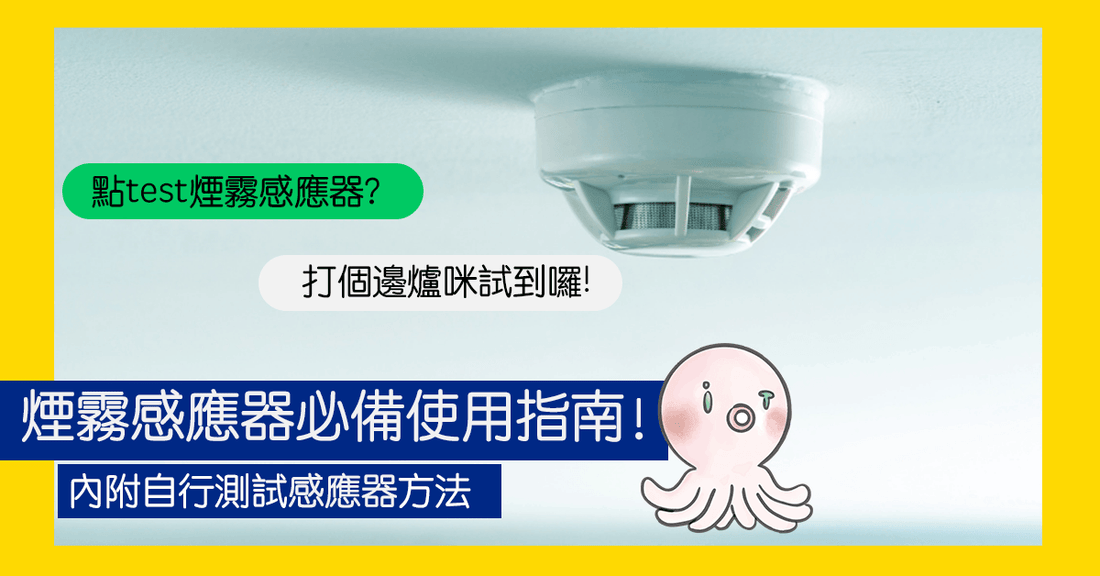
Fire accidents have always been one of the primary causes of casualties in Hong Kong. As the saying goes, "a single spark can start a prairie fire," so it is essential to implement proper fire safety measures in homes and offices. Installing fire detectors—especially the common smoke sensor—in your residence or workplace is a highly effective way to prevent fire accidents. However, even if you purchase one, it may prove useless if you don't know how to test its effectiveness; you might only discover it is malfunctioning after an accident occurs, which could lead to dire consequences. Must you host a hotpot party with friends just to test it? In this article, I, your editor at LINKO, will teach you how to test smoke sensors yourself, explain the principles behind them, and cite the latest safety guidelines for fire detectors issued by the Fire Services Department to provide you with 5 tips on setting up fire safety alerts.
- Principles of Fire Detectors (including Smoke Sensors)
- Installation Methods for Fire Detectors (including Smoke Sensors)
- 3 Tips for Choosing a Fire Detector (including Smoke Sensors)
- How to Test Smoke Sensors Yourself
Principles of Fire Detectors (including Smoke Sensors)
According to the guidelines from the Fire Services Department, independent fire detectors are typically palm-sized fire detection devices that emit an alarm once activated by a power source; the volume must be sufficient to alert people within the building. Different independent fire detectors operate on various principles. Common types function by detecting substances produced during a fire—such as smoke, heat, or combustion gases—and then issuing a warning signal to the user.
It is important to note that independent fire detectors are distinct from fire safety equipment that meets legal specifications—that is, fire detection systems mandated by law for installation in buildings, including those required in commercial buildings, industrial buildings, restaurants, care homes, and other licensed premises. Those systems require hard-wired connections and involve many complex system components. In contrast, the independent fire detectors mentioned in this article are standalone devices, mainly categorized as smoke or heat sensors, comprising a buzzer, battery, and test button, with very few additional components. (For details, please refer to the image below.)

Installation Methods for Fire Detectors (including Smoke Sensors)
The installation of independent fire detectors is quite simple and requires no special skills. Detectors usually come with a base plate, which can be easily fixed to the ceiling surface using adhesive tape or screws. Some bases come with 3M double-sided tape to ensure the detector sticks firmly to the ceiling, after which the detector can be attached and used. Some may ask: "Must smoke sensors be installed on the ceiling?" Ideally, yes! Because hot smoke rises, reaches the ceiling, and then spreads outwards, the best installation position is on the ceiling, followed by high up on a wall. For units with high ceilings, pay attention to the sensor's specifications regarding its maximum detection range.

Additionally, the Fire Services Department suggests that residents install an independent fire detector in every room, including bedrooms, living rooms, and dining rooms (excluding kitchens and bathrooms to avoid false alarms), to achieve the best fire safety protection. However, if you only want to install one detector in a unit, it should be placed near the main escape route, such as in the living room near the bedroom area.

3 Tips for Choosing a Fire Detector (including Smoke Sensors)
- Must pass international/national standards

- Must have mobile notification function
Today's independent fire detector technology is mature. Some smoke sensors can be used in conjunction with smart home systems. Unlike standard sensors that only sound an alarm, some smoke sensors that connect to a smart hub can allow you to monitor home safety in real-time anytime, anywhere via your mobile phone. Once a fire triggers the detector, your phone will receive an immediate notification. This allows you to coordinate with devices like CCTV to identify the cause and location of the fire, alert family members or neighbors to help fight the fire, or even notify firefighters for rescue—achieving truly effective and safe fire protection.
- Pay attention to the information on the packaging or device label, including:
- Type of detector
- Product standard or certification body mark
- Date of manufacture or replacement
- User manual (including installation and maintenance details)
- Battery performance
How to Test Smoke Sensors Yourself
Most common fire detectors have a test button on the front to check the alarm performance. Simply press the test button; a normal detector will emit a loud alarm sound. If it does not, you should replace the battery or the unit itself. The Fire Services Department also recommends that users press the test button at least once a month, or according to the manufacturer's suggested interval, to ensure the audible alarm is functioning properly.
But how do you test the actual smoke-sensing function? You can visit stores specializing in fire safety equipment and buy a product called a Smoke Detector Tester (aerosol). The one I am using, a test spray, was purchased at a fire equipment store in Kowloon Bay (the Firex website) for about HK$120. Once you have it, simply spray it towards the smoke sensor continuously for 3 seconds or more. If the smoke sensor is working correctly, the test gas will trigger the alarm, causing it to sound and potentially send a notification to your phone.
Test video:
If you happen to need a fire detector for your home or workplace, the smoke sensor from LINKO iot is an excellent choice. It has obtained CCC safety certification. Besides the standard fire alarm function, as a smart product, it can connect to your mobile phone via a smart hub to receive fire notifications through the LINKO iot app. The battery is sufficient for 5 years of operation. Users can also utilize the automation features of the LINKO iot app to execute commands once a fire is triggered, such as cutting off power to smart devices or turning on home CCTV cameras. Furthermore, one device can be shared among multiple users, ensuring everyone receives notifications and no one misses a fire alert.
FAQ
Where should smoke sensors be installed?
The ideal location is on the ceiling, as hot smoke rises to the ceiling before spreading; the next best is high up on a wall. The Fire Services Department recommends installing one in every room (excluding kitchens and bathrooms to avoid false alarms); if only one is to be installed, place it near the main escape route.
How do I test a smoke sensor myself?
Press the test button on the front of the detector; it should emit a loud alarm. The Fire Services Department recommends testing at least once a month. To test the sensing function, you can buy a Smoke Detector Tester aerosol (approx. $120) and spray it towards the sensor continuously for 3 seconds or more to see if it triggers the alarm.
What should I look for when choosing a smoke sensor?
Look for products that have passed international standard certifications (e.g., CCC, UL), and ideally, those with mobile notification features. The LINKO iot smoke sensor is CCC certified, has a 5-year battery life, allows fire alerts via the app, and is available in stock as official Hong Kong goods at LINKO Shop (linko.shop).
